
Perhaps it’s a sign of the times but almost every major automaker at this week’s 2010 Detroit Auto Show had some kind of electrified vehicle on show, with everything from battery-powered supercars to hybrid urban runabouts taking center stage.
Until the recent past, pure electric vehicles and hybrids have mostly been the domain of the eco movement but thanks to the efforts of companies like Tesla, which have shown that electric powertrains can be applied quite successfully in sports car platforms, mainstream automakers and consumers alike are starting to catch on to the notion that electric vehicles can be both green and fun.
While most of the electrified vehicles were still concepts, they do offer a glimpse of what we could all be driving in the new future. Here’s a rundown of what was unveiled today:

Audi e-tron Concept
With the unveiling of its latest all-electric show car, Audi now has three different concept vehicles grouped under the same “e-Tron” nomenclature. The good news is that one of them will be heading to production in 2012 so best start saving now. Unlike the previous e-tron concepts, the latest uses two electric motors instead of four, driving the rear axle and making this car essentially a rear-driver. Performance is strong at 5.9 seconds for the 0-62 mph sprint and 37-75 mph being covered in just 5.1 seconds, which means passing should be a breeze as well.
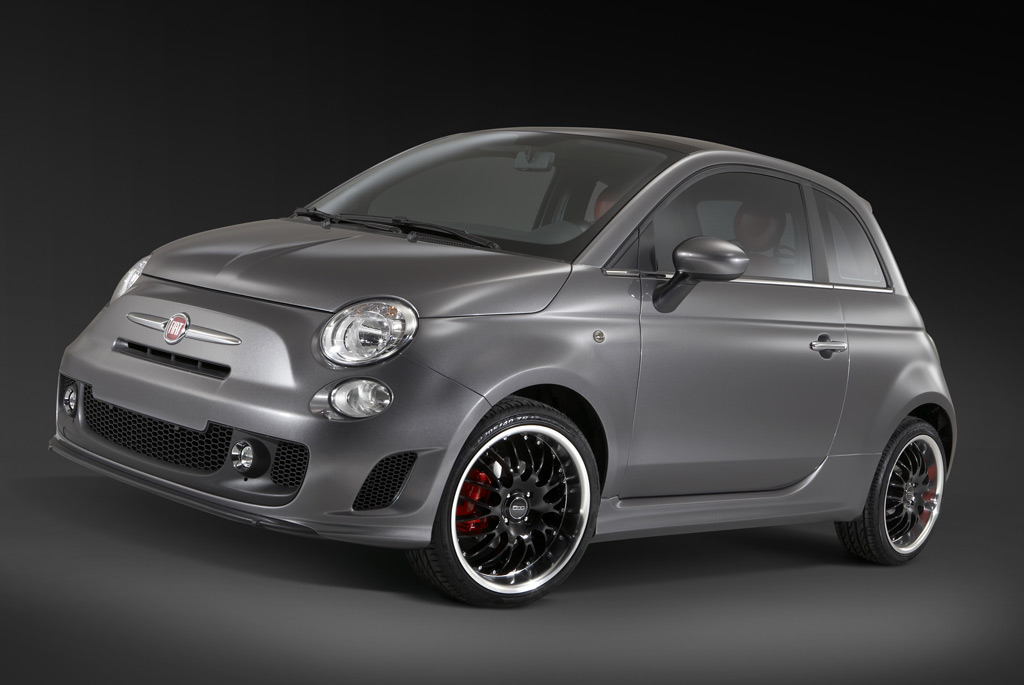
2010 Fiat 500 BEV
Easily one of the most likeable electric concept vehicles we’re ever likely to see, the deliciously retro Fiat 500 BEV shoes that eco-friendly motoring can be as stylish as it is clean. Packing similar technology and performance to the MINI E from BMW, the new Fiat 500 BEV is purely a concept and sadly, there are currently no plans for production. Chrysler explains that it was created in order to investigate packaging of an electric powertrain in a smaller vehicle.

2012 Ford Focus, at 2010 Detroit Auto Show
At last year’s Detroit Auto Show, Ford startled everyone by saying it would offer a fully electric Focus in 2011. At this year’s event, Ford pulled the covers off its all-new 2012 Focus and this is the car that will eventually be offered with the automaker’s zero-emissions electric powertrain. The Focus BEV should have a range of about 100 miles but if this runs out, an onboard battery charger will be capable of plugging into a 110 or 220-volt outlets and charge times will vary from about 6 to 12 hours depending on the outlet type used.

2011 Honda CR-Z
Honda CR-Z
One of the few Detroit electric cars that will actually be on sale this year, the 2011 Honda CR-Z is one of the first takes on a sporty hybrid, and one the automaker hopes will bring an element of fun and style to what is still regarded as a sleepy segment. Powered by a 1.5-liter four-cylinder mated to Honda's Integrated Motor Assist (IMA) hybrid system, the CR-Z is good for 122-horsepower at 6,000 rpm and 128-pound-feet of torque from 1,000-1,500 rpm.

2009 BMW Concept ActiveE
BMW Concept ActiveE
In March of 2008 BMW first announced plans to establish a new research division called “Project i,” whose task would be to develop a number of solutions for a vehicle designed for congested city motoring. The goal of Project i was never to exclusively develop one type of vehicle or another, but to come up with a range of technologies BMW could introduce across its fleet. Last year’s Mini E electric vehicle was the first tangible evidence that Project i was in action and now BMW has followed it up with the Concept ActiveE all-electric vehicle based on the 1-Series Coupe. Powering the concept is an electric motor located in the rear axle, making it rear-wheel drive. Peak output stands at 170 horsepower and 184 pound-feet of torque, which is enough to offer 0-60 mph acceleration times of approximately 8.5 seconds. Top speed has been limited to 90 mph.

Toyota FT-CH hybrid concept car, 2010 Detroit Auto Show
The new Prius has only been out for a few months, but already Toyota is previewing concepts of what looks like another body style for the Prius platform. Called the FT-CH, the latest concept previews a hybrid vehicle that’s less expensive than the current Prius, targeting a new, younger and less affluent generation of buyers, with fun and innovative styling.

2010 Volkswagen New Compact Coupe Concept (2011 Volkswagen Jetta Coupe)
Sleek, stylish and designed to slot between the Scirocco and Passat CC in the VW lineup, the New Compact Coupe Concept is also thought to presage the next Jetta Sedan and even, possibly, a Jetta Coupe. Packing an advanced hybrid powertrain and 7-speed dual-clutch gearbox, the New Coupe Concept can reach speeds of up to 141 mph while still returning an average fuel economy of 56 mpg. Peak output from its 1.4-liter TSI engine and electric motor combo stands at 177-horsepower.

Volvo C30 BEV
Volvo has some ambitious plans for the future. In addition to the market launch of a plug-in hybrid in 2012, work is currently under way on evaluating the viability of an entirely electric-powered car. Taking the stylish C30 hatch as a base, Volvo engineers have installed an electric motor and an array of lithium-ion batteries, which they claim can carry the car a distance of 94 miles between charges.
MORE:
If all this talk of sporty electric vehicles has you itching to get behind the wheel of a battery-powered car right now, your best bet is to call up the guys at Tesla. And don’t worry, if you’re still troubled about not being able to take an electric vehicle out on the open road, Tesla drove one of its electric roadsters from Los Angeles to Detroit for today’s show. Ranging over 2,700 miles and requiring 16 employees, the trip shows that electric vehicles aren't just toys for the rich....or at least that they're practical toys for the moderately wealthy.
Later this year Fisker will launch its luxurious Karma plug-in hybrid sedan, with first deliveries tipped to start in the third quarter. The Karma was first showcased as a concept as recently as last year’s Detroit Auto Show and since then the project has rocketed towards the production horizon.
And finally, whispers heard in Detroit suggest that Acura will launch its first hybrid vehicle in the near future but so far no model has been specified.
_______________________________________