

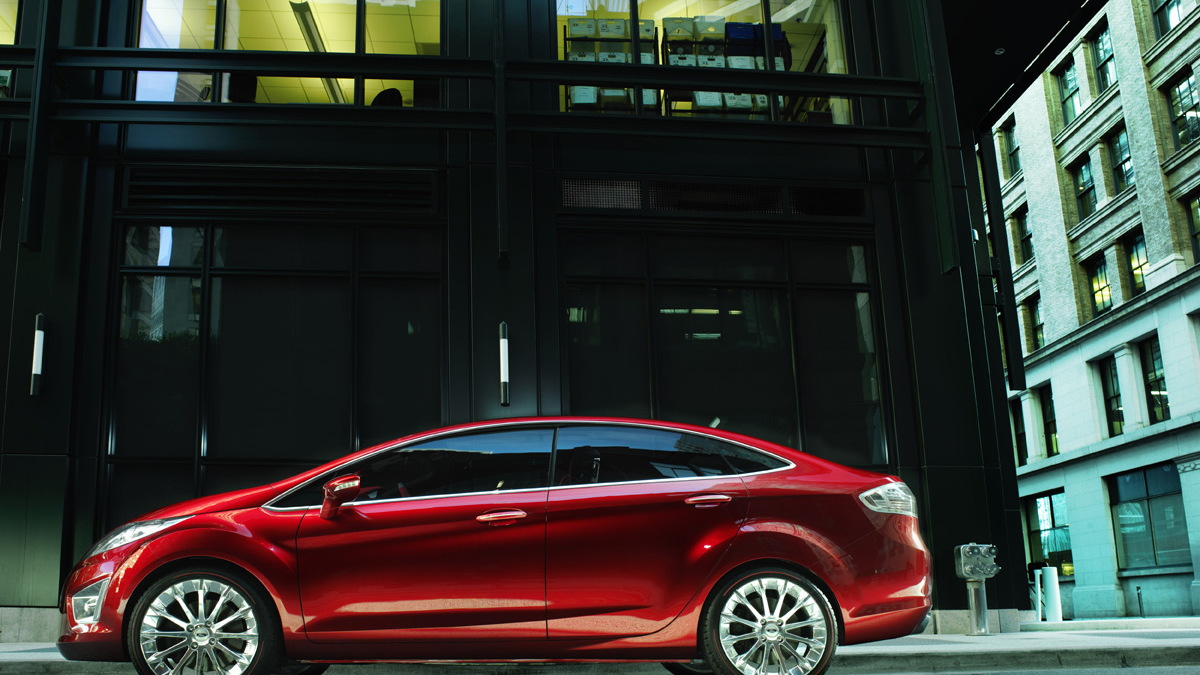

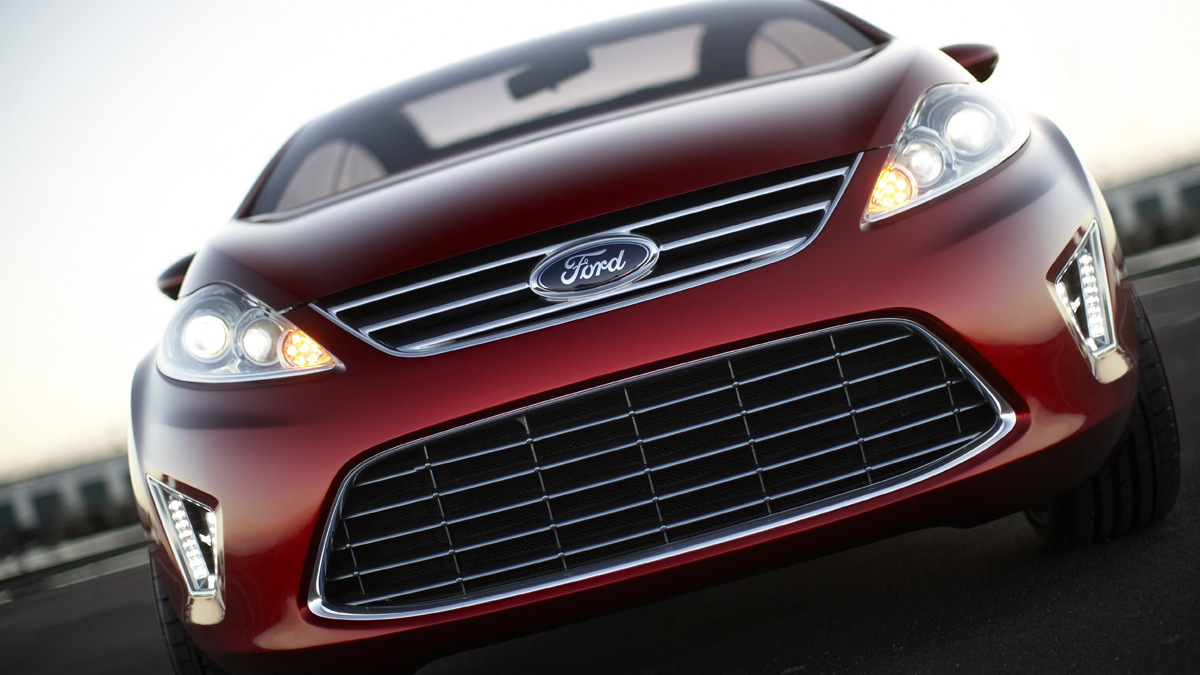

The Verve concept has been developed with Ford’s new global product development strategy, which better leverages the company’s global strengths and reduces development time and cost. The North American Verve sedan, painted in Rouge Red, has been modified slightly from its European and Asian counterparts and features a completely new front-end.
Under the car's hood sits an economical four-cylinder petrol engine that powers the front wheels. Other features include LED highlights, a mobile phone inspired center console and 18in alloy wheels.
* New Ford Verve small car concept showcases the style, technology, premium materials and more substantial content that will set it apart from other offerings when Ford’s new small cars go on sale in North America in 2010.* Four-door Verve is designed to appeal to “Millennials,” the fastest-growing segment of the population, as well as their parents – with sophisticated technology and expressive design demanded by globally savvy customers.
* A European three-door Verve concept also is being displayed at the North American International Auto Show to test North American reaction to an alternative bodystyle.
* In the U.S., small-car sales are predicted to increase by more than 25 percent through 2012. Small cars and crossovers are the only vehicles with projected near-term growth in the U.S.
DETROIT, Jan. 13, 2008 – Ford Motor Company is revealing the Verve, a concept vehicle that makes clear the vision for the new small cars Ford soon will introduce in North America.
The Verve is bold and sophisticated – to help it clearly stand out from other small cars on the road. Ford is building on decades of small car leadership in Europe as it develops new small cars for North America to appeal to increasingly savvy customers who value technology, design and fuel efficiency.
Both four- and three-door Verve body styles are being unveiled at the North American International Auto Show in Detroit, as curtain-raisers to a new global family of small cars set to debut in Europe and Asia beginning later this year and in North America in 2010. The four-door is the basis for the production vehicle that will be sold in North America. The European three-door is being shown to test market reaction to the bodystyle – as a possible additional small car for the North American market.
The Verve concept has been developed with Ford’s new global product development strategy that better leverages the company’s global strengths. Globally, Ford is building on its European small-car expertise to stake a bigger claim in this critically important segment. Ford’s celebrated small car lineup in Europe includes such top-sellers as the Ford Focus, Fiesta and Ka.
“We’re looking at every aspect of what’s defined Ford as a small-car leader in Europe and working to build on this expertise in driving dynamics and design across a global family of Ford cars that are as exciting to drive as they are to look at,” said Derrick Kuzak, Ford’s group vice president, Global Product Development.
“The Verve concept family provides a vision for a new world standard for quality, design and comfort in the small car segment,” Kuzak added. “These concepts demonstrate how leveraging our global strengths can yield attractive benefits for our customers in markets around the world.”
Those benefits include a bold, modern, design along with sophisticated electronics, premium materials, surprising functional space and a fuel-efficient 4-cylinder engine – all previously unseen in this segment.
Small Car Popularity Skyrockets in North America
Momentum in small-car sales is outpacing overall industry growth worldwide. Globally, small car sales have grown from 23 million units in 2002 to an estimated 38 million in 2012. That’s nearly 45 percent of the total expected 85-million unit industry, a level never before achieved. In the U.S., sales of small cars likely will grow by 800,000, or 25 percent – to a record 3.4 million units by 2012.
In fact, small cars and crossovers are the only vehicles with projected near-term growth in the U.S.
Driving the growth in the U.S. market is a group of young people aged 13 to 28 years – dubbed “Millennials.” Today, this group stands 1.7 billion strong worldwide and will represent 28 percent of the total U.S. population by 2010.
As a group, Millennials embrace eco-friendliness, stay in constant touch using modern technology and demand best-in-class products from around the world. This group will grow from representing 19 percent of the driving public in 2004 to amassing 28 percent in 2010.
Every day, 11,000 Millennials in the U.S. come of driving age. When it’s time to buy their first car, nearly half of this group shops the small-car segment.
“Millennials will be the defining group of customers in the future, driving all types of consumer trends,” said Jim Farley, Ford’s group vice president, Marketing and Communications. “Ford’s European-based cars are a great fit for this generation of drivers, who have grown up with the Internet and mobile phones as necessities, not luxuries – believing that bigger isn’t necessarily better, precision is everything and technology rules.”
Verve Redefines Small-Car Segment
The Verve concept demonstrates that largesse is no longer the price of admission for a delivering a premium driving experience.
“The Ford global design team remembered, not so fondly, the econo-boxes of the 1970s and created the Verve concept as a vision of just how good a small car can be,” said J Mays, Ford’s group vice president of Design and chief creative officer. “Verve aims to ‘right’ North American buyers’ earlier small-car experiences by offering a product that changes customers’ views of small cars from ‘cheap’ to chic – and from affordable to desirable.”
The Verve concept is built off of a design architecture flexible enough to yield three distinctive vehicles that are each recognizably Ford. The flexible design architecture also allows Ford to adapt quickly to rapidly changing customer tastes and will help the company enter new markets utilizing regionally tailored products off of a common platform.
The North American Verve sedan, painted in Rouge Red, has been modified slightly from its European and Asian counterparts – most notably in its front fascia.
Designers created a bold, three-bar graphic with a Ford blue oval in the upper grille opening and downsized the lower, inverted trapezoidal grille. Two unique LED side markers flank the front fascia.
What carries through all three global concepts are Verve’s sophisticated design language and its inspiration: A modern world of fashion and cosmetics, echoed in the Verve’s rich colors and distinctive, high quality materials.
The hood sculpture is toned and athletic but not overtly muscular. This form language combines with the more pronounced, rearward-stretching headlamps to give the face of the Ford Verve concept a friendly, open and inviting personality. The prominent headlamps feature two projector beams and a light-emitting diode (LED) array.
From the side view, the concept looks energetic and purposeful. Its profile is emphasized by the pillarless side window shape and the upper contour that mirrors the body’s curving upper contour line.
This extends rearward from the angular A-pillar to marry the sculpted, semi-high-mounted, LED tail lamps sculpted to become part of the fullness of the body shape. These elements blend cohesively together and support the vehicle’s panoramic glass roof.
The 18-inch, 12-spoke, two-piece alloy wheel design lends even more drama to the car, punctuated with a subtle sidewall stripe that complements the rich body color.
Other accents on the vehicle include a discreet chrome bar in the door handles and similar use of brushed aluminum on the lower grille surround, the rear license plate surround and on the lower edge of the front fog lamps.
Technologically Inspired
Verve’s unique architecture embraces key electronic systems such as navigation, a dynamic sound system and in-car phone controls. Aesthetically, the Verve interior follows the curves and contours of the instrument panel shape.
Functionally, the center stack design decouples traditional elements of the entertainment system – the screen, control elements and the electronics. Separating these features allowed designers to position controls for optimal ergonomic positioning in a design that resembles the logic of a mobile phone.
The center console includes a tray for a mobile phone or MP3 player as well as a large bin for a purse near the handbrake. The center stack is a unique combination of sculpture, colors, materials and jewelry-like brightwork.
The concept’s climate controls, highlighted in a lozenge shape at the midpoint of the center stack, feature large twist dials that were inspired by the sculpture found in high-quality power showers.
The primary gauges – speedometer and tachometer – are uniquely framed by binocular-shaped, short tunnels of brightwork that complement the center stack and contrast the rich interior colors like a fashion accessory.
Ford Verve concept’s steering wheel is another work of sculpture. Its center section, sculpted of soft-feel material and framed in brightwork, provides a rich tactile and visual centerpiece for the Ford oval.
“Customers in this segment demand the best,” says Mays. “While young in age, they are sophisticated, globally connected and demand the best the world has to offer, be it consumer electronics, fashion or automobiles. The Verve concept shows people that when it comes to style and sophistication, Ford can compete – and even outshine – the best in the business.”
Ford: European Small-Car Know-How
Driven by a new global product development system that leverages Ford’s global strengths, Ford designers in Dunton, England, and Cologne, Germany, developed the common small-car platform based on the converging tastes of global consumers.
Ford maintains small-car leadership in Europe with vehicles set apart by their world-class driving dynamics and dynamic designs.
With more than five million vehicles produced in Europe since it was launched in 1998, the Ford Focus is one of the only vehicles in the world to be named “Car of the Year” both in Europe and in North America. It is Ford’s perennial top seller in Europe and, in 2007, was Europe’s top-selling car in its class.
The Ford Fiesta – which is smaller than the Focus – debuted in 1976, and it has sold more than 12 million units in Europe.
The iconic Ford Ka redefined the small city car sector in Europe with its eye-catching and enduring design and fun-to-drive character when it was introduced more than 11 years ago. Sales remain strong – with more than 1 million cars sold.
The European Ford Fusion – introduced in 2002 – increased its sales by approximately 19 percent in 2007 versus the previous year and remains in the European top three sellers in its segment.
“We’re known in Europe for uniquely executed small cars, and this is the perfect time to bring this expertise to buyers in North America,” Kuzak said.
Verve Sedan Concept Specifications
Overall length
145.35 in.
Wheelbase
97.99 in.
Overall width
65.12 in.
Overall height at curb
54.33 in.
Track width
Front
58.03 in.
Rear
57.32 in.
Front Overhang
32.05 in.
Rear Overhang
57.32
Headroom
Front
37.8 in.
Second Row
35.83 in.
Legroom
Front
42.09 in.
Second Row
32.76 in.
Powertrain
Fuel efficient 4-cylinder engine