
What’s largely been replacing them over the past decade—electric power steering systems (EPS)—make a lot of sense on so many levels. With current and an electric motor, mounted closely, providing the assist, they have small packaging; they’re mechanically simpler; they’re touted as more reliable; and they weigh a lot less. And because EPS only uses energy when you’re turning it boosts fuel economy and lowers emissions.
Steering might not affect ultimately how well a vehicle performs, but it certainly affects how much confidence you have behind the wheel—and how much satisfaction you get from the driving experience. While these systems work just fine for most owners, there’s been unease among enthusiast types for years—with claims that in some vehicles EPS yields an artificial, digital feel and unnatural weighting.
It’s rare that we get to take questions like this straight to a steering expert, an experienced engineer, or an industry insider. But at a recent ZF technical event we were able to just that. Here are excerpts of our very thought-provoking, nuts-and-bolts Q&A session with someone who fits all of those roles: Scott Montgomery, Systems Integration Manager at ZF Steering Systems:
-----
Why does electric power steering elicit such strong and wide-ranging views (on how it should or shouldn’t be) when hydraulic power steering is generally taken for what it is?
It was always very difficult to get a good-feeling hydraulic system, but people became used to accepting some of the weird nuances of it. In general, hydraulic steering wasn't bad; there were some really bad systems and there are some really good ones.
And I think it's the same way with EPS. EPS started off 10 or 15 years ago, and the first systems on the market were bad; there's no discussion, they didn't feel good, they made all sorts of noises they weren't supposed to, and EPS became a four-letter word in the industry. Nobody wanted to touch it. Especially those OEMs that had tried it early on and got completely fried by it. It was really a fight to convince them that the new systems are actually a lot better than what you had in the past.
What specifically makes the second and third generation of EPS that much better?
In the initial days, it was a very rudimentary system. Somebody nailed together the parts and came up with some control strategies that seemed to work—left was left, right was right—and you could adjust the assist level. But nobody really put a lot of thought into the idea of what are you missing from a hydraulic system, that you need in order to make it feel more natural. And to be honest, I think some vehicles today are lacking some of that in their systems. It all comes down to being able to generate or transmit a feel in the steering wheel that fits your mental perception of what the vehicle is doing.
So specifically, a lot of times what you'll see is that you have systems that lack damping. You turn into the corner and it feels okay turning in, but coming out, it just wants to fall back to center, and your natural motion is that you turn in, you have a certain effort progression, it needs to be a linear progression of effort and response. Today what happens with those ‘bad’ systems is that you go up on a good torque curve, and coming back you either have too much or too little damping. Some of the worst systems require a good amount of force going into the corner, then the torque just falls away and the steering gear just wants to slam back to center. Subjectively, you want to feel like you go right up an effort curve and then back down the same curve—it needs to feel the same loading and unloading. Anything else is unnatural.
Even the earlier systems used resistive torque-sensor technology, and they were subject to heat, misalignment, and wear over time, so you didn't get a very accurate signal back to the control unit, to let the driver know what's happening. Today you can pretty much breathe on the steering and you'll see some reaction. The motors are better too. Early systems used brush motors; now they're using bruchless motors that are quieter, and there are a lot of failure modes we no longer have.
Can you tune pretty much any desired feel into the steering with EPS?
Yes and no. You have to have the right algorithms for it to happen—especially with respect to damping. There are some guys who have a damping algorithm that we wouldn't use; and while the system might provide assist in the right way it wouldn’t allow us to generate damping in the places its needed. So if you're using a system like that you're never going to be able to get it to feel the way you want. If our competitors don't understand why they don't need a different damping algorithm, then that's part of our competitive advantage.
To put it a different way, how much flexibility do you have to customize the feel in each car?
Quite a lot. There are some places where we shake our heads and say, “It's what the customer wanted,” it's not what we would recommend and we can't go in and say that the customer is completely wrong, but in those cases we make our suggestion and say, hey we would do this a different way. But at some level, when the customer wants it, they get it. And there are a number of vehicles out there where I could say if we'd had more say we could do it a lot better.
Nissan Autonomous Emergency Steering System
In these 'assistance functions,' like automatic parking, lane keeping… We simply provide an interface to another module. For lane keeping a camera module will determine that you're getting close to the edge of the lane and they'll request a torque from us. So from a steering standpoint it's there. It's the overall system, together with the vehicle, that's needed to make the autonomous driving safe and reliable—that's where we need more work.
The steering technology is there, and we could steer the car today. We do it with the parallel-park assist; and it can do it at high speeds. Obviously [to bring it to market] you have to get to higher levels of safety, and that drives up cost, but it could be done today.
Speaking of safety, what failsafes are there for EPS? Are there fail-safes within the system that will warn the driver in advance of a loss of assistance?
There’s a lot of work put into the safety, and making sure that when the system does fail, that it's still controllable by the driver. So if you had some sort of failure that caused the motor to apply full torque; we have diagnostics that will shut completely shut it down in the 10-12 millisecond time frame. When we do that, it's because something went wrong with the hardware, or the software, if we have a memory error or something like that, it could cause serious repercussions and you don't want to wait.
There is work going forward on 'failsoft' strategies—meaning if we detect a failure with one component of the system and we can shut off just that component and still utilize the system to limp home. The sports cars that have really light front ends, maybe okay, but if you have a big car it requires muscle. For example if a motor phase has a short, we just shut it off; but we still have two functioning phases, can we use those for a 'soft landing' to drive to a safe place?
carbon fiber steering wheel
It depends on the vehicle class. If you look at it in terms of a premium hydraulic speed-dependent steering system, plus hoses, plus cooler, plus pump, plus oil, plus all these other components you had to add to the system, it's getting close to the same price, but not equal. And it's very, very dependent on production volume. In small-volume vehicles it still costs much more, because it's an expensive technology to develop.
What saves money really is the reduced warranty claims. You’re dealing with an all-electronic system, and over the life of the vehicle, the reliability of an all-electronic system is generally better than that of mechanical components. Warranty numbers have followed that; and it's not just claims for failed steering components. So-called 'pull-drift' claims, where the automaker ends up paying for a new alignment, and the customer has to schedule around a service visit, even though a very slight issue. go way, way down. The EPS will correct for a slight ‘static offset’ like that, and it isn’t an issue for the vehicle or tire wear. But we do have to decide where to draw the line. If we start compensating for disturbances in the vehicle, it could cover 50,000 miles before it gets a new set of tires, and it does lead to additional wear in the suspension. So you have to find a happy medium where you eliminate this 'nuisance level' where it doesn't cause any issue to the vehicle, but you cap it at a certain level.
Microsoft XBox 360 wireless steering wheel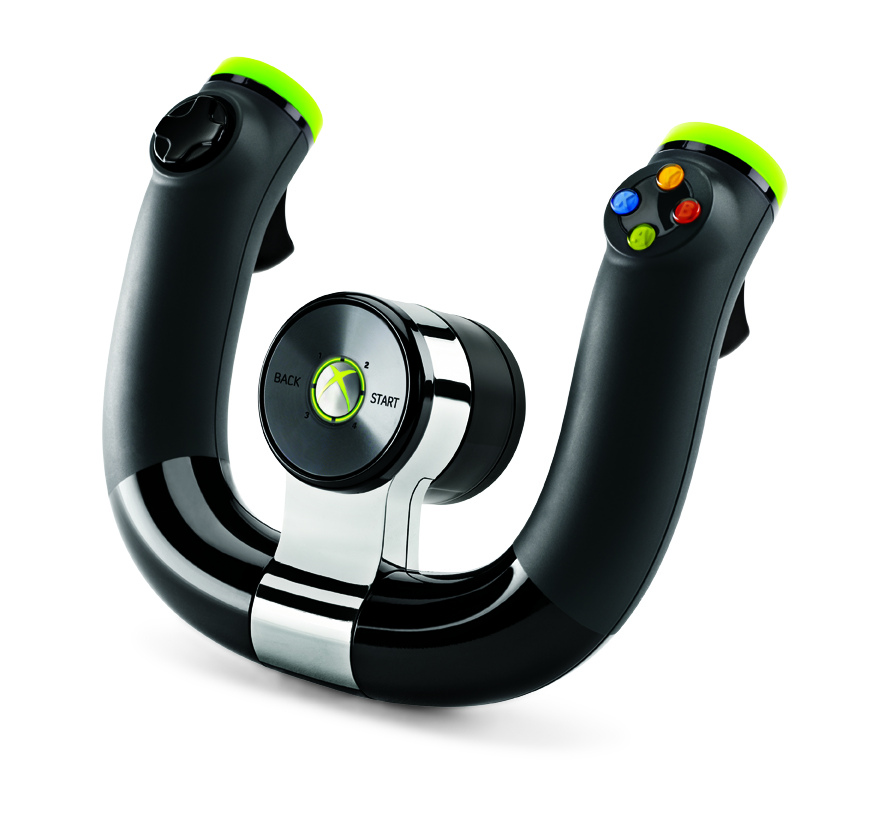
We have the technologies to do it. From my understanding it's the European market that still has the regulation absolutely requiring the physical link. So if we're going to do it, [because of the investment] you have to do it in all the markets or it doesn't make sense.
We’re already testing steering-control algorithms that basically cancel out everything coming in to the driver first—then there are features where you add in the wheel torque, based on what we ‘feel’ at the tie rods. You can do it quite well; it's not as artificial-feeling as you might think when hearing the concept, but in essence you're coming back and generating your steering feel. It's all there; it's just a matter of getting somebody fired up enough so that we put it into production.
-----
What do you think about the electric power steering in your newer vehicle? And if you have another question about electric power steering in general, write it out in the comments below and we’ll try our best to get an answer.
-----
This Q&A was conducted at an event in which ZF covered accommodations and some travel expenses.