
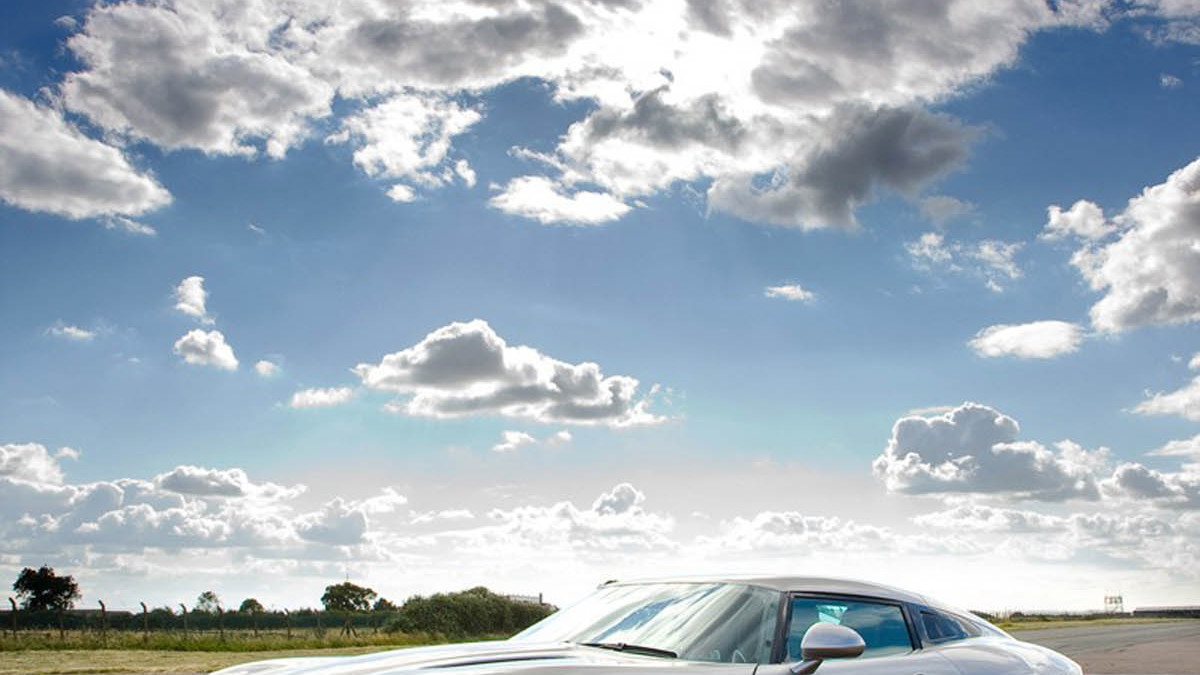
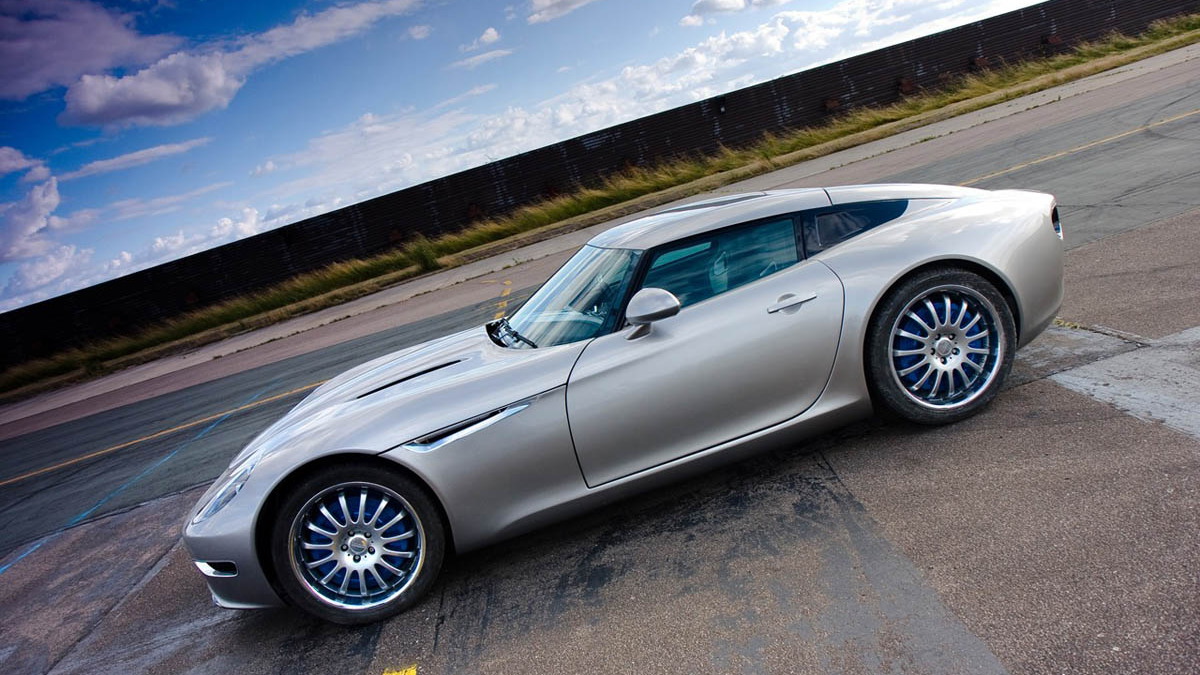
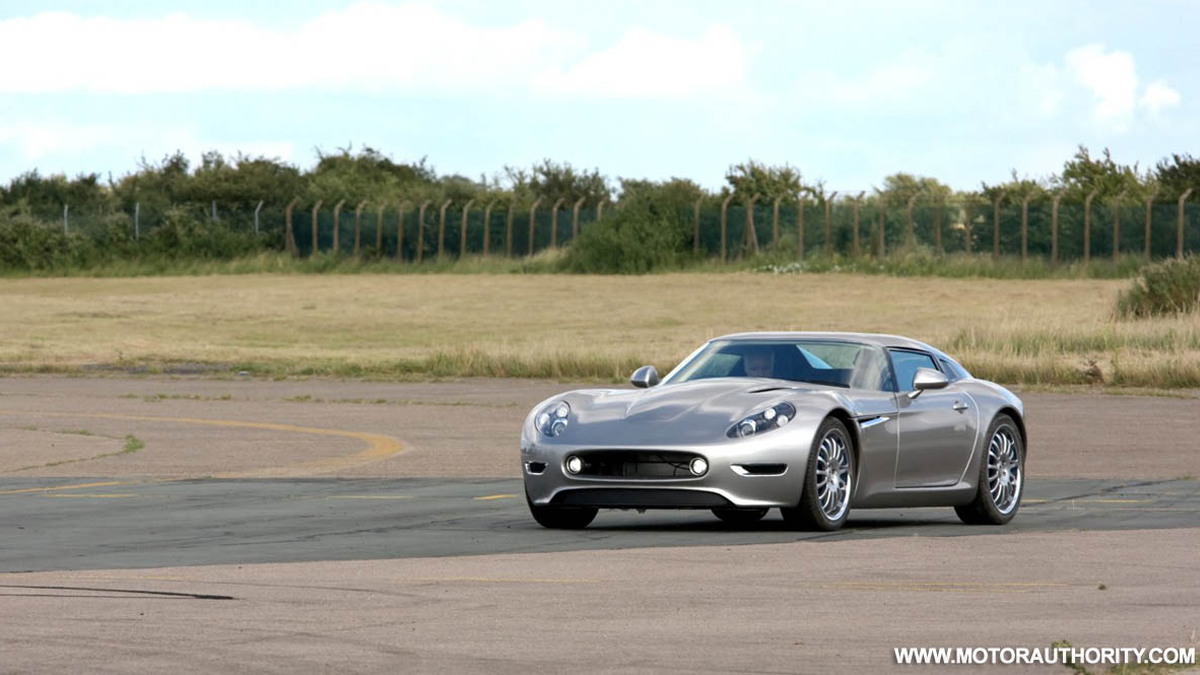
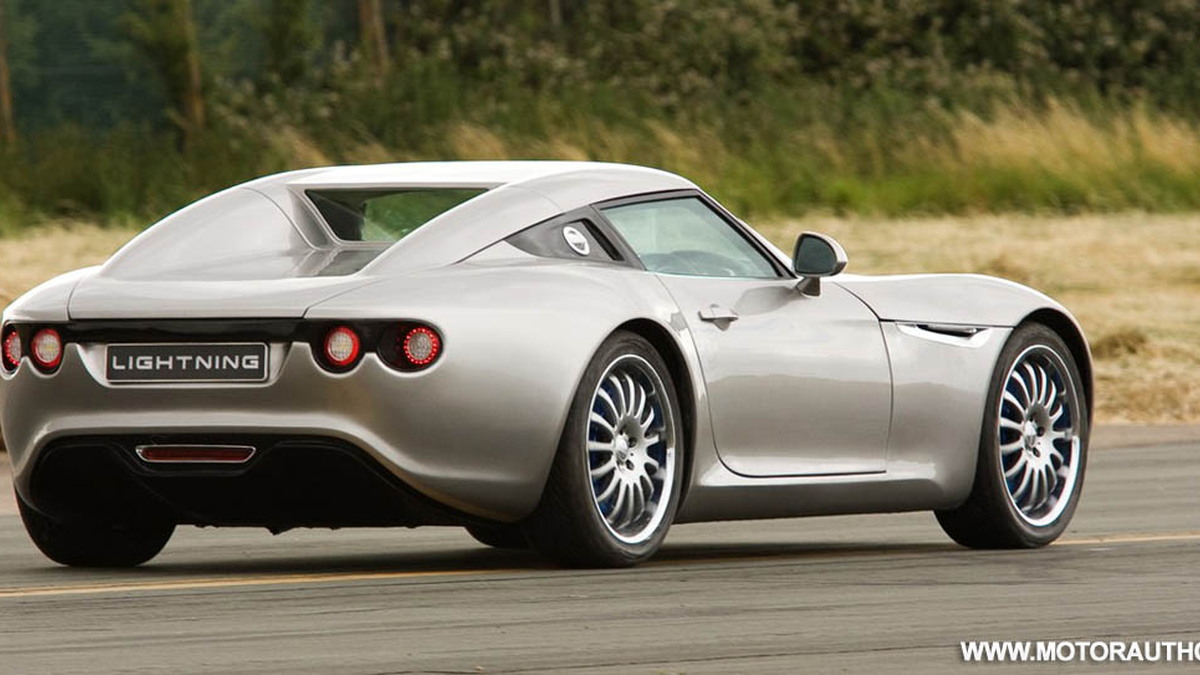
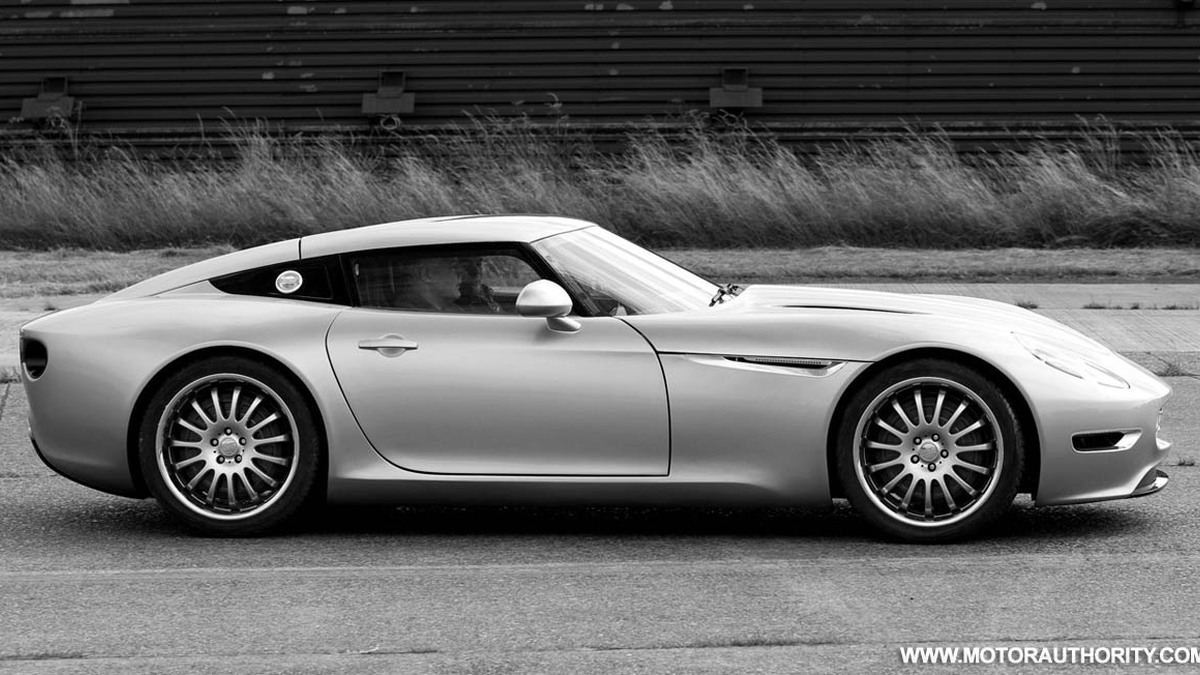
lightning gt photos motorauthority 001

The Lightning GT is powered by a permanent magnet brushless motor located in each wheel
Enlarge PhotoFollowing its debut at the London Motor Show earlier this year, Britain's answer to the
Tesla Roadster, the Lightning GT electric sports car, is expected to move to the next stage of development in 2009. The team behind the Lightning GT has announced that they will be producing two prototypes by the second quarter of 2009, with a view to start the first customer deliveries in early 2010.
Information at this point is scarce, and currently the car's exact specifications have not yet been finalized. Meanwhile, the company behind the project is still seeking capital from investors and an exact location for production is also still uncertain, which all means that the promised delivery date may need to be pushed back.
Some of the details we know about include a 700hp (522kW) electric powertrain featuring nano-titanate battery technology, which is enough to propel the car from 0-60mph in a flat four seconds and take it a top speed of about 130mph.
The electric drive system, dubbed Hi-Pa Drive, packs four permanent magnet brushless motors with one in each wheel. The system also allows for full traction control and regenerative braking on all four wheels independently. Due to power being developed separately in each wheel, there are no gearboxes, differentials, axles, drive shafts or propshafts in the Lightning sports car.
One of the key benefits of electric vehicles is that they have maximum available power at the wheels at any speed, unlike a petrol engine where maximum power is only obtained high up in the rev range. Officials claim charging the batteries for just ten minutes will provide up to 250 miles of driving, and at current prices driving one mile will cost just 2.5 cents.
To save weight, the car’s body is made from carbon fibre and Kevlar, and even with the full array of batteries on board the GT has a near ideal weight distribution of 48/52 front to rear. The car is also available with
luxury items such as air-conditioning, satnav, and full leather trim.
Lightning GT Photos
Lightning
Have an opinion?Join the conversation!
By chris Posted: 3/5/2008 12:07pm PST
now the big question... how much does it cost?
By Raptor Posted: 3/5/2008 12:47pm PST
By Raymand Posted: 3/5/2008 1:17pm PST
Am I misinformed?
By JD Posted: 3/5/2008 1:27pm PST
By Jezza Posted: 3/5/2008 2:02pm PST
http://www.lightningcarcompany.com/technology.php
By Gus Posted: 3/5/2008 3:30pm PST
By chris Posted: 3/5/2008 3:47pm PST
raptor: the cable wouldnt need to be that large. cable size is based on current. its likely that these motors are high voltage motors. voltage doesnt determine cable size. high tension power lines are running in the 115kV and up range, and are no larger than 2" around yet supply electricity to entire cities. because of the increase in voltage. 10 minute changing is no problem. the cable could be as small as a heavy duty extension chord (although beefed up insulation would be needed for the higher voltages). the reason why a 10 minute charge time is impressive is because batteries act as a load in a charging condition and thus emit heat which damages the battery.
raymand: jezza got it right. yes, max torque is available at all RPMs but power in an electric motor is a function of the current through the windings; something easily controlled by the controller. power isnt exactly torque*rpm, its torque/time, or more generally, work/time. because max torque is available at any one instant, max power is available at any one instant as well. they go hand in hand. strictly speaking however, when you're talking about a rotating shaft, torque is all you care about.
JD: the environmental benefit is very clear if you know the electric power generation industry. every power plant in the western world (including the very dirty coal generation) is much cleaner than any internal combustion engine for personal transportation in production today. you see, even trains pollute less because they're a little less "throw away" so more advanced technologies are put into these items than say, a similar diesel truck, or your TDI jetta. power plants are the same way. theyre built with 50 years of operation in mind. millions of dollars worth of technology are invested to make the generation as efficient as possible, and then environmental standards require that the exhausts are filtered in ways that car exhaust will never be filtered. its like comparing your car engine to your lawn mower. they both put out probably the same amount of pollution but one is much much smaller and delivers much less power. yes, the electricity coming out of the wall isnt exactly clean, but even if it was entirely coal based, it would still be cleaner than a prius. imagine this: gas stations getting demolished and replaced with some sort of green station. one that sells electricity for cars at higher premiums than the other electricity fillup stations because this one doesnt pull from the dirty grid but actually makes its own hydro electric power on site. imagine having an EV and living in ontario, quebec, or north eastern US. all your power comes from niagara. you're driving a 0 impact car.
not to mention it regulates the power industry,.. unlike what some people say. some people argue that theres already an electric power shortage. the problem isnt capacity but peak capacity. think about it... the california brown outs were happening in the middle of the summer, in the middle of the day. hottest temperatures call for the most airconditioners. i can assure you that your local utility's loading goes down to about 30% at night. imagine if everyone was plugging in their cars during that time. power distribution would get regulated.
if this idea sounds absurd to you, read up about ice fueled air conditioning. its used in big buildings because large buildings pay for electricity based on peak power demand, not the amount of energy they consume. they can keep their peaks low by using electricity at night and freeze large blocks of ice, to be used by the air conditioning system during the day.
By C6R Posted: 3/5/2008 5:43pm PST
Ridiculous lame! From where? From a powerplant directly?
Maybe they want to sell this car to powerplants only :)
By Gus Posted: 3/5/2008 6:40pm PST
There is no doubt that the electric car is the best idea, and if they can truly charge the battery in 10 minutes (and you know this is going to get shorter and shorter) then I am willing to wait an extra few minutes to fill up.
The only other problem I see is what happens when you run out of juice away from a recharging station? You can't just have a tow truck bring you a can of gas. Will tow trucks of the future carry around supplemental power in the form of a generator or battery pack that can charge you car enough to make it to a charging station?
I, personally, look forward to an electric Mustang GT convertible (I know, blasphemy, the exhaust sound is half the fun, right?). Endless torque, no noise. Wouldn't bother me a bit. And I have always longed for an silent powerboat, silent off-road motorcycle (I wonder how you would rescue that if you ran out of power, can't just siphon electricity, can you?), silent airplane with solar panels on the wings and elevator. The most fun I had as a pilot was taking an ultralight to 10,000 feet and turning the engine off to glide all the way back down...
By Jim Posted: 3/5/2008 6:51pm PST
By admin Posted: 3/5/2008 9:05pm PST
Q. How does the Lightning charge its battery system?
A. The Lightning has a built in battery charging and control system. Simply plug the car's charging lead into your home's electric power point and you'll soon be charged and ready for the next journey. The lead is 12 feet long (optional 20 foot extension cable available). The electronics take care of various power sources that it can receive power from. It's as simple as that! There are a number of different sources that can be utilised with this cable and charging times can vary depending on the state of the batteries and also the power source chosen.
Q. How will the Lightning be charged away from home?
A. Standard single phase home type power source can be used to charge overnight and is available just about anywhere by using the onboard charger. For a fast charge a 3 phase power supply is required and with the interest in electric powered vehicles increasing significantly, more high power charging stations will be installed. Most garage forecourt and industrial areas already have this level of high power source available and therefore can be fitted with a universal charging station.
By 86treuno Posted: 3/5/2008 10:23pm PST
the front end is how a aston martin should look like and the maserati can take some cues from overall body styling and apply it to their future models
By Gus Posted: 3/5/2008 11:28pm PST
I'm sure what we'll see eventually is a "gas" station where these high power charging stations are available, once a standard is agreed upon and batteries are found that can quick charge and don't deteriorate over time.
By Paul Posted: 3/6/2008 3:40am PST
An all electric Fiat (using the same type batteries) traveled 186 miles with 3 recharges with a 3 phase external charger. The Phoenix trucks only claim to go 100 miles. It has to have a high powered external charger as well to make the 10 minute charge. The on-board charger takes 6 hours. And to top it all off the Lightning GT has more motors.
To use a line by Gary Busey in "Gumball Rally", if this car does what it claims I'll eat my Airedale.
By peste Posted: 3/6/2008 8:55am PST
By Plenny Posted: 3/6/2008 9:30am PST
By chris Posted: 3/6/2008 3:14pm PST
as the admin has pointed out, 10 minute charging is done with 3 phase, 600 volt power. much more energy capacity than a single phase 120 volt service in your house. and really, if you think about it, a 10 minute charge at a station is the only time u need it, if your charging at home, an hour or two charge time will do just fine.
also, thats not a complete charge. there is what is called "trickle charging" which more effectively charges the battery and i would expect this car has been designed for a trickle charge time of 8 hours.
realize the battery technology used in this car is ridiculously advanced.
gus: realize that every gas station needs electricity to power the pumps that get the gas into your car. where theres a gas station, there could be a charging station. 3 phase power is available almost everywhere, and certainly everywhere there is a gas station standing today.
THIS CAR right here is the reason why i like hybrids. it gets giants like gm, toyota, and ford, thinking in kWh's and not MPG's. THIS IS THE FUTURE. MUCH cheaper, safer, and with higher theoretical output than hydrogen fuel cells. and not to mention, its cleaner too.
think about this: in a hydrogen economy, a power plant would make electricity that is used to separate water. hydrogen is transported PHYSICALLY to you. you use it to turn it back into electricity. all it is is a storage medium. its a battery.
in an electric economy, electricity is sent across the nation at very high efficiency through wires with VERY little loss, and you charge your car. no physical transport of millions of gallons of hydrogen...
and like i said, the storage capacity of batteries is already higher than that of hydrogen. hydrogen is just a sexy pipe dream.
By chris Posted: 3/6/2008 3:25pm PST
By bob Posted: 3/11/2008 4:22am PDT
By chris Posted: 3/11/2008 9:37am PDT
By az Posted: 3/15/2008 5:05pm PDT
By chris Posted: 3/17/2008 9:08am PDT
the movement of the car could be used to charge the batteries? you must be thinking about kinetic watches or something along those lines (kinetic watches require very little power compared to the energy that your body makes to move. they simply extract some of that energy and turn it into time-keeping energy).
Remember the most fundamental law of physics. energy cannot be created or destroyed, only transformed. this is an all electric car that will turn electrical energy into movement. what your saying is to take that movement and turn it back into electricity to turn it back into movement? you ARE missing something because in the end, you're saying that the kinetic energy of a car can be used to create that same kinetic energy in the car. this is perpetual motion, and it is heresy. energy can only be converted from one form to another. in the standard car, chemical energy is turned into mechanical (rotational) energy. in an electric car, electric stored energy is converted into rotational energy. what your suggesting is a car that takes the energy of its movement and stores it, in order to make it move again. this would only work in a perfect world where energy conversion is perfect, energy storage is perfect, and theres no friction, air resistance, or any sort of losses what so ever. you could pump a car full of energy and make it recover anything it uses. in a perfect world.
By Delby Posted: 4/11/2008 2:01pm PDT
By Fernando Teixeira Posted: 4/13/2008 4:51pm PDT
Well, I am writing from Portugal, and currently I am working in a private company that is doing what is possible to be more friendly environmetal.
This is not a easy task, because so many solutions at the end are not what they seem, but just marketing "Green", but not so Green.
My biggest doubt here is about bateries, because I am not a technitian, and for example the Prius it seems that the bateries are not so good for environment as the car it seems, and How about bateries of Tesla and Lightning Car Company?
I have studied the sites of Tesla Motors ( www.teslamotors.com ) and the Lightning Car Company ( www.lightningcarcompany ), and it seemed to me that the Tesla site was better concerning information, but if I had money I would buy the Lightning.
First - I would say, that urgent and important is that this techonology must be monotorized by Environmental Organizations to certify them or not, and then about electricity there is being happen some developments for the near future that this might be a solution, and just please look at this site:
http://1366tech.com/v1/
Second - Apply urgently this technology to other cars and not only for sport cars, and spread it to all automotive industry, in order that scale production reduces greatly the cost.
Well, I just would like to say that "Tornado" was not a well know word in Portugal, but last week happen twice.
So, things must be done and quickly.
Good luck for Tesla and Lightning Car Company, that I hope they will set up a new standard in industry, it is a pitty that they do not have capacity of production enough, and so very probably other trademarks do not feel afraid.
I hope others might appear to shake up...
Fernando
By MARIO Posted: 7/7/2008 7:40pm PDT
then we are heading in the right direction. But, technically something is fishy here.
The CHARGING SYSTEM on this car sounds impractical. But, beautiful and working
toward a feasible EV, well, gotta give 'em credit for that. Let's see what develops
in the very near future.
By chris Posted: 7/7/2008 10:31pm PDT
nothing is wonky about these claims at all. the power of electricity!
I just want to say that its great that this car is really coming to fruition. as far as electric systems are concerned, a 175 hp motor is nothing, and putting one on all 4 wheels isn't very difficult. these electric drive systems have been in industry for decades... i should expect a thansition to electric vehicles to follow the manufacturability of the batteries very closely.
By bambam Posted: 7/7/2008 11:43pm PDT
Lets see, What about the price? Oh wait someone mention it already.
I like the looks anyway.
By Boris Posted: 7/8/2008 6:37am PDT
A fast run if the Lighning company can hold its promises - Tesla let thier (ADVANCED-paying) customers down for 4 years in a row.
The Lightning car is, if the tech spects are becoming only halfway true, a century advanced above
the comparable technical "primitive" setup of the Tesla "soap-box" approach.
Beyond the Teslas Lotus body there is not much technical advanced we did not had 1910 - even less...
Boris - A burned Tesla evangelist...
By Ivan Posted: 7/22/2008 6:13pm PDT
I would capitalize on the fact that I don't need the bulky engine, and come up with non-traditional car design.
By mcw Posted: 7/22/2008 8:50pm PDT
By Dandan Posted: 7/23/2008 1:50am PDT
By Gus Posted: 7/23/2008 2:34pm PDT
By Carlos Posted: 7/28/2008 1:50pm PDT
By boney Posted: 8/3/2008 11:26pm PDT
thanks
By Steven Posted: 8/5/2008 4:57am PDT
By lexlife Posted: 8/5/2008 11:27am PDT
By P_Denver Posted: 8/5/2008 5:38pm PDT
With new battery technology we will see more and more all-electric cars being promoted. They will work. The first few may not be practical, but eventually we will be driving them around town. Distance may continue to be a problem, but commuting travel will not be an issue.
By Arthur Pappas Posted: 8/6/2008 11:34am PDT
By Mark Reynolds Posted: 8/9/2008 2:18pm PDT
Did you know that it's possible to build a full sized electric vehicle (EV), freeway capable for more than 100 miles per charge with batteries that last the life of the vehicle, and with air conditioning and power windows, etc. (not the costly Tesla). This is without research into Lithium or other exotic batteries (like the Tesla) but instead with proven Nickel Metal Hydride (NiMH) batteries. This car has been on the road for 10 years now as an embarrassment to the entities that stand against the existence of an electric vehicle: It is the Toyota electric Rav4, and there are about 600 of them still operating in California.
The "research required" line we have been told repeatedly is misinformation, which unfortunately, most of us believe.
Who does not want EV's in our driveways:
-Big Automakers, because they, and their dealer networks do not earn significant revenue by selling cars. A look at how large their service departments are (and our out-of-wallet experience with them) shows what's at stake revenue-wise because EV's never need service beyond tire changes. EV's don't even need brake jobs due to electronic regenerative braking that does most of the work. Their ordinary friction brake pads and rotors thus last the life of the car (as shown on the Toyota electric Rav4).
The large established car companies depend on their service department, like printer companies depend on sales of ink cartridges. So why did Toyota sell the Rav4 instead of leasing and crushing as GM did with the EV1? It's a mystery, but I came across a blog that mentioned that a Toyota exec at a public speech mistakenly said that the cars would be sold, and so to save face, Toyota reluctantly sold the Rav4. Buyers, however, now post on blogs that they actually had difficulty in getting the Toyota dealer to sell them an electric Rav4 and that they were highly pressured to instead buy a Gas Toyota or a Prius. As a journalist, you can probably resolve this apparent contradiction of why Toyota would build the Rav4 EV but not want to sell it.
-Large oil companies, for obvious reasons. Note they are also major stockholders in auto companies and thus have influence over their board of directors. Note that it takes only 6% of stock ownership in a company to be able to force them to allow you onto their board. This flaw is extensively being exploited by so called "activist investors" to invade companies and then to ruin them by making them split up and be sold, etc. For the auto firms, though, the oil companies mearely make sure EVs do not make it out of "research".
Business firms exist to make profits, but profits are going to be reduced if EV's replace the ICE (Internal Combustion Engine) car. Much of our economy is based on the automobile, and its upkeep. Almost every business is related in some way to the car. What will happen to employment if the need to service a car is reduced?
What happens to Midas, Pepboys, Kragen's, smog check, AMCO, gas stations, Jiffylube, general service repair centers, the manufacturing plants that fabricate repair parts, the UPS people that deliver the parts, the corner deli or Taco Bells frequented by those firm's workers at lunchtime? What about government agencies that depend on collecting all manner of tax revenue from the above interlinked economy?
If people understand this scenario, then they will understand why they can't yet buy an EV from the legacy business infrastructure. Only recently can one sniff the scent of a potential EV from upstart EV boutique manufacturers like Tesla (too costly for mass production partly because they hand-solder a battery pack of 6000 Lithium flashlight battery sized cells together in series-parallel groups, and it is a difficult feat to electrically balance the cells so that they work together and share the work equally lest some over-tasked cells be strained and thus fail, eventually causing the whole pack to fail), Aptera, BugE, etc., because a startup company does not need to address the risk that a service-free vehicle will parasitically affect revenue from other parts of its company.
Curiously, besides Mitsubishi, Nissan's CEO has advocated a pure EV but I have a hard time believing he really will build one and that the announcement is mostly PR in nature. After all, Nissan has their cash-cow service departments too.
What could replace displaced jobs from the ICE economy? Anyone who has flown from California to Florida has seen that most of the American land in between is empty and that a sizable portion of it is desert-like with plenty of sun exposure. This land could be loaded with massive solar and energy storage farms. This would employ a sizable workforce to build and then to maintain them. Solar farms could be photovoltaic or solar thermal. Energy storage, for evening power delivery, could be networks of batteries, massive flywheel generators, or pumped water elevated reservoirs for hydro power generation. Costly? Yes enormously so, but so was the Manhattan Project and so is the Iraq war, national ventures not undertaken for profit and thus cost justification. How much of the above could have already been built with the funds spent in Iraq? Some people advocate nuclear power, but I would encourage solar as being risk-free. One exciting company in my city of San Jose, Nanosolar http://www.nanosolar.com/ seems to have developed solar photovoltaic panels at 1/10 the existing cost. They can print them off like sheets of a newspaper.
Final Comment: There is a viable battery already proven to last the life of an electric car and to provide a driving range of more than 100 miles between charges; the "95 AH (Amp Hour) NiMH Large Format" battery. This powers the Rav4 EV.
This battery is no longer sold (why?), but instead a much smaller capacity battery, a 10 AH NiMH battery is sold to go into the hybrid cars we now drive. This smaller 10 AH capacity battery insures the car still mostly runs on gas. A web search will reveal that a major oil company holds the patents on this battery, and they sued Panasonic for 30 million dollars and had the factory that made them dismantled.
There are many web sites that explore these issues. Google: "Rav4 EV" or "95 AH Large Format NiMH battery", or you can visit this EV web site: http://www.evprogress.org/ which has various links and research.
By Michael D. Posted: 8/14/2008 10:50am PDT
I wonder if this will reach USA shores?!
By Justin Posted: 9/15/2008 10:10pm PDT
mcw & boney; the tokyo highway makes me uneasy. theres a law in science about energy not being created or destroyed, only converted. it is the reason why you cant put a wind mill on your car and then expect the car to get up to speed and be powered by the same wind mill you're pushing (see a recently posted article on this site that suggests theres a firm in britain doing exactly that. in truth its an electric car made by a green energy provider that is "selling" you green power to charge your car). basically, i dont trust those claims. scientific convention says that if a road is making power because a car is driving over it, then that power is actually coming from that car. theres no such thing as magic, and there is no free lunch.
carlos: exhaust tip? you mean that low slung brake light? cause i cant see anything in those ground effects.
arthur.. very paranoid view, if you dont mind me saying. who taxes your power consumption? who regulates the power industry.. hell.. the government OWNS the power industry in parts of the world. the truth is that fuel cells potentially have much more power than any conceivable battery technology.. so hydrogen fuel cells are really seen as the best sort of "end game". a half a gallon of hydrogen has just as much "tank to wheel" energy as a 20 gallon tank of 87 octane.
mark reynolds: no... comment. actually... to hell with that. say what you want about big business in america but there are countries and corporations that are big enough to market this magic car you speak of. i think the demand for such a wonder product is clear.. and i think GM's efforts to do a plug in hybrid are well documented. we dont see these products yet for a reason. go visit japan, scandinavia, and other tech leaders like that.. tell me that advanced technology is being suppressed by big oil. and then pass me what ever you're smoking.
justin: electromagnetic generator?? you mean.. the way that effectively ALL electricity is generated? its a motor in reverse. you spin the shaft and you get electricity on the windings.. the problem is how do you spin the shaft? the answer: in nuclear plants.. through nuclear fire making steam that spins a turbine.. coal, makes steam,.. spins turbine... natural gas turbines.. hydro electric dams spinning generators... the problem is.. finding a "green" way to spin the shaft. now.. if you're talking about the so called "motionless electromagnetic generator", you'll find that its just a concept that violates the most simple and basic fundamental laws of physics.
ken: i've definitely made a point of killing THIS thread specifically because this car really is amazing. advanced battery technology will be the new "engine development". electric motors are already very very good with little room for improvement, and electric drive systems are spectacular in theory and practise. the only problem is getting the power to the motors. but the admin of the site has already approached me for writing for this site, though i find my "free" time sporadic at best. i haven't really visited the site since the summer because i've been busy at work and over the next 8 months i suspect i'll be pretty silent on the whole. but it's definitely greatly appreciated.. your comments.
I thought i would add a comment about advanced battery technology. anyone who wants to read further about these things need to check out the following things: EEStor and ZENN motors out of toronto, and UltraCapacitors.
By ps3 games Posted: 10/26/2009 3:09am PDT
The Lightening can go 300km on a single charge that only takes 10 minutes. And many people would gladly pay the 120,000 -160,000 pounds...and it goes zero to 94km in 4 seconds!
Great looking vehicle though.
By Darren Posted: 11/26/2010 1:59pm PST
By Darren Posted: 11/26/2010 2:08pm PST
Have an opinion?Join the conversation!