CAFE won't kill the Camaro, but will force it to adapt

 
Follow Nelson

chev camaro spy01 1

CAFE won't kill the Camaro, but will force it to adapt

CAFE won't kill the Camaro, but will force it to adapt

Enlarge Photo
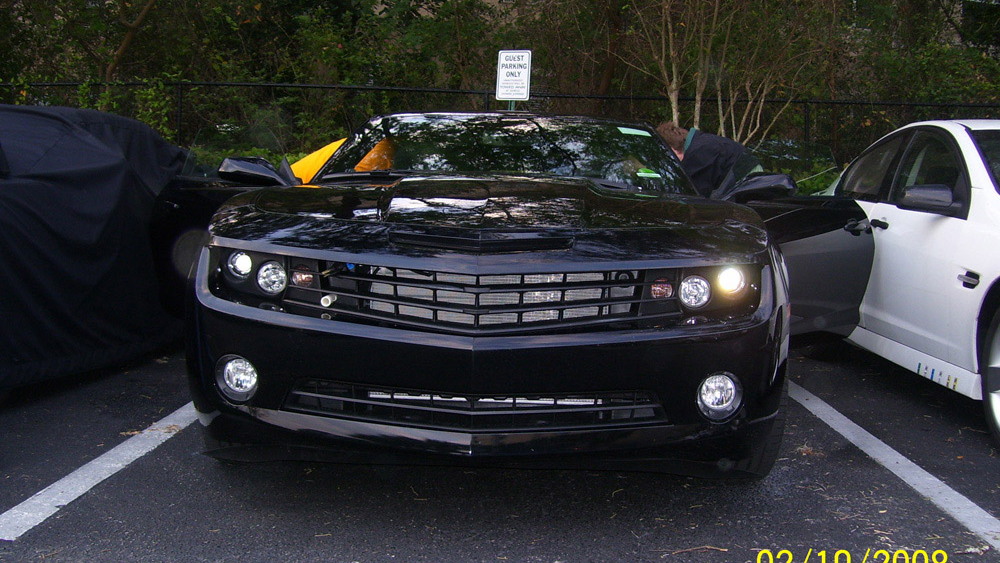
Yesterday word leaked on the UK getting a shipment of right-hand drive Camaros, and it seems the company is determined to move forward with a full-scale launch of the car. Believing the platform is equally well suited to V6 and even four-cylinder engines as the more traditional V8s, General Motors thinks the Camaro can fit into a CAFE-centric future.

The thirsty, high-power V8 Camaros will only be a part of sales, according to GM vice president of sales and marketing Mark LaNeve in an interview wtih Edmunds.

"Everyone thinks we'll be positioning the Camaro as a burn-ass hot rod," he said. "But that's only about 30% of the business. The other two-thirds will come from 27mpg V6 sales, with a significant female share."

The V6 LaNeve spoke of was spotted last week by spy photographers. A four-cylinder is also in the works, as Bob Lutz said in March. The precise nature of the smallest mill - or even if it will ultimately be used in the Camaro - isn't yet decided, but the most likely scenario is a 2.0-2.5L inline four with the aid of a turbocharger for better power while maintaining acceptable fuel efficiency.

The downsizing engine trend is something GM will be taking throughout its model line, as well. Powerful six-cylinder cars will replace V8s, and turbocharged or normally-aspirated fours will replace the older V6s. CAFE might not kill these cars, but it will force them to evolve by the time they arrive in 2010.

2010 Chevy Camaro high-res spy shots


Follow Us


Have an opinion?Join the conversation!

  • Posting indicates you have read this site's Privacy Policy and Terms of Use
  • Notify me when there are more comments
Comments (9)
  1. The V6 engine, let's say similar to the 3.8L that powers some Buicks and Pontiacs, is still big and thirsty, and I don't think a 2.0-2.5L in line four turbo (not a very small engine yet with force induction) is going to be very fuel efficient considering the body weight of the Camaro. In my opinion, the new Camaro may be very stylish, but it's going to have to go on a diet to meet the CAFE standards...
     
    Post Reply
    Vote
    Bad stuff?

  2. Sigh ... GM's still standing frozen in the headlights, blinking. They should cut their losses, make the Camaro a specialty vehicle built in lower quantities and focus on econo-boxes for a while.
     
    Post Reply
    Vote
    Bad stuff?

  3. burke, if a dodge ram can do 80 mph with only 4 cylinders, then why wouldnt a 4 banger turbo be good enough for the camaro? you only need big power to accellerate, and little power (we're talking 30 or 40 hp to cut the air) to keep moving. if cylinder deactivation works, then turbo charging would work even better. if you're only using half the engine most of the time, then why have that half anyways? if you can force feed 4 cylinders all the time, you'll do just fine.

    the problem with cars like this is people expect the kind of drive you get from a V8. lots of low end toque, and a nice big grunt at the end of your foot. you can make a turbo charged 2.0L I4 with 300 hp. everyone makes them. they just dont feel the same as a V8. they'll go just as fast, but half the fun is seeing all the people's heads turn as you rumble along the strip.

    This car will sell just fine, but peoples conception of "too small of an engine" or "too little power" will have to change for the base models of every car from now on. Most people never use anything more than a small percentage of the power of their cars.
     
    Post Reply
    Vote
    Bad stuff?

  4. Defenitely not the best time to introduce this car or the Challenger.

    But lots of V6 sales and female buyers is nothing new, I think a huge portion of Mustang sales are V6's and female, or am I wrong?

    I want my carbon fiber Mustang, with a 400 mile range electric motor, 5 second 0-60 time, and 5 minute charging batteries NOW, dammit, NOW! :)
     
    Post Reply
    Vote
    Bad stuff?

  5. Chris, CAFE regulations are about gas mileage, basically. I think your ideas are about power. In physics, Power = Force x Velocity. According to this, (for example) all 250hp engines are expected to expend similar amounts of gas. The differences are that a V8 250hp engine can deliver that power at lower rpm's (greater force, lower speed), and smaller engines deliver the power at higher rpm's (lower force, higher speeds). That also explains the difference in engine response when you hit the gas. You can feel the kick of the big engine right after you hit the gas. In small engines the kick happens at high engine revs. Force delivered by a piston is proportional to the size of the cylinder, so smaller engines will need the extra assistance (force induction) to reach higher rpm's. Here is where the turbo does its part. Turbos add little to none power at low rpm's, they also cause engines running hotter, dirtier and lots of engine wear. But they can deliver massive power at high rpm's...
     
    Post Reply
    Vote
    Bad stuff?

  6. If they do put a 4-cyl in the Camaro it wouldn't be a first time. The early/mid 80's Camaro was offered with a 2.5L 5, Pontiac's Iron Duke, I believe. Paired with short ratios in first & second gear it was reasonably peppy around town, but you wouldn't want to pull out to pass. Of course the upcoming Camaro will probably way 1000# more.
     
    Post Reply
    Vote
    Bad stuff?

  7. 27 mpg V6s? WTF? Ask anyone who owns the last of the Camaro/Firebird...27 highway mpg with the 6 speed and the "big thirsty V8" is quite commomplace. Yet another sign of how much more bloated and brick-like nature of this new Camaro.

    On a tangent, CAFE is absolutely retarded. The market should be the dictator of what mpg vehicles achieve. If the auto buyer wants to drive 50 mpg tin cans the automakers would then meet that demand. If the auto buyer wants massive ultra high-powered 15 mpg vehicles they should be free to do so without consequence. They will pay more in fuel costs but that shoudl be their choice. This is actually proved in the curent slump in SUV sales. These stupid CAFE standards had nothing to do with that...there was a large shift in demand. This is supposed to be a free market in a capitolist society, not a nanny-state. Oh, right... I forgot. We want the kind benevolent government to protect us from ourselves.
     
    Post Reply
    Vote
    Bad stuff?

  8. The only place the inline 4 will excel is in highway driving a one constant speed. I own an inline 4 truck, and with a 5 speed manual tran. it gets over 30 mpg highway on 87 octane, but city driving can cut that almost in half. The only way to get good mpg city is to pair the inline 4 with a light body and an awesome transmission and from what I hear the present generation of Camaro is going to be anything but light.
    This could be a good idea, but needs to be better implemented and more thoroughly thought out.
    Burke has it all wrong. A turbocharger does not aid in the engine reaching higher rmp's, it pushes more air into the cylinder than the piston can on its own allowing more power to be generated (more air equals more fuel dumped into the cyl. and more power). I simplify a lot, but depending on the size of the turbocharger, number (two smaller would be better); a reasonable amount of power would be generated almost right away. Power in a turbocharged engine is proportionate to boost, so more power will be generated at higher boost and higher boost is generated a higher speeds. But as I said boost will build from the start and most research says that even a 3-5 lb. boost will give upwards of a 50% increase in power on larger engines (3.5L). And as long as you keep your engine from using a lot of boost all the time your vehicle will be fuel efficient.
    Tornado346 has is all right about CAFE standards. The market will dictate the trends in cars more than any law ever can. Besides such a law should not be about mpg, it should be about pollution caused by burning a unit of fuel through an engine.
    MPG will come from the consumer, but I am not sure about pollution per unit of fuel.
     
    Post Reply
    Vote
    Bad stuff?

  9. 4 cylinders, 6-8 cylinders, whatever, I just want this car. Definitely plenty of AM engine upgrades.
     
    Post Reply
    Vote
    Bad stuff?


Have an opinion?Join the conversation!

Connect with Facebook

Motor Authority. Now with your friends.

Discover stories your friends read.
Share stories more easily.
You control what you share.
Learn more

Research New Cars

Go!

 
© 2011 MotorAuthority. All Rights Reserved. MotorAuthority is published by High Gear Media. Stock photography by Homestar, LLC. Send us feedback.